
Technology 5 min read By Morgan Griffin
Tiny Dental Robot Could Streamline Crown Procedures
Researchers at the University of Basel have developed a prototype dental robot, MIR, that could reduce the number of appointments needed for dental crowns by automating tooth preparation with high precision.
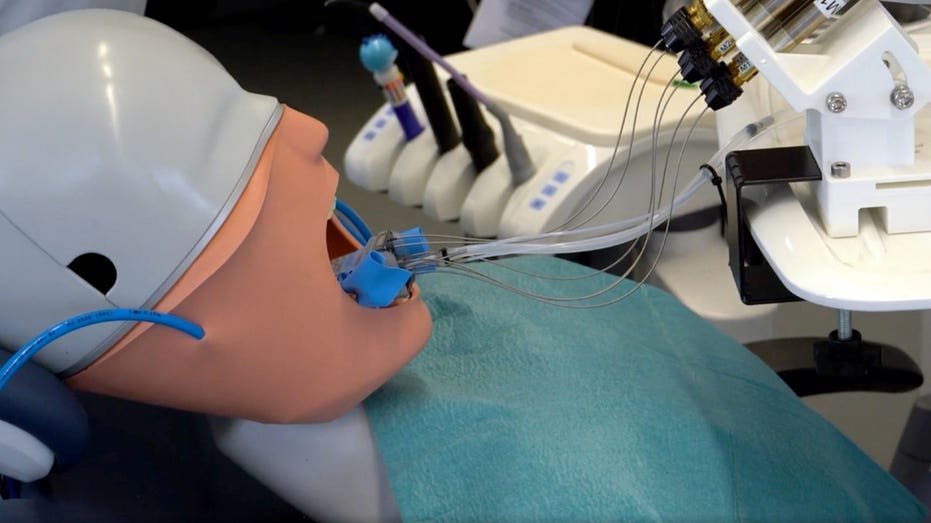
A small dental robot under development at the University of Basel in Switzerland could one day transform the process of getting a dental crown, potentially reducing the need for multiple appointments. The prototype, named MIR (Miniature Intraoral Robot), is designed to prepare teeth for crowns with digital precision, moving much of the traditional workflow into a computer-guided system.
The robot, about the size of a wine cork, measures 43 by 26 by 28 millimeters. Its compact design is intentional: the larger motor and control components remain outside the patient's mouth, connected to the in-mouth unit through flexible drive shafts, cables, and tubes. This setup aims to keep the device unobtrusive while allowing the dentist to maintain a clear view of the treatment area.
MIR attaches to a custom-fitted dental splint made from a patient's scan, ensuring that if the patient moves their head, the robot moves with them. This feature addresses a common challenge in dental procedures, where even slight patient movements can complicate precision work. The robot follows a digital treatment plan created from an initial scan, which could allow the dentist to order a permanent crown immediately rather than waiting for a separate appointment.
In testing, MIR prepared tooth models made of synthetic resin and ceramic material with hardness similar to tooth enamel. The robot performed the preparation in two stages: first using a wider drill to reduce the top surface, then a longer, thinner drill to shape the sides. Researchers reported a positional error of less than 0.2 millimeters, even without sensors to directly measure or correct its position. The forces generated during drilling stayed below five newtons, comparable to the gravitational force of a half-liter bottle of water.
The long-term vision for MIR is a fully digital treatment workflow for tooth preparation, where crowns could be manufactured before or during the procedure using CAD-CAM dental technology. This could eliminate the need for temporary crowns and return visits, streamlining a process that currently involves multiple steps: removing decay, filling the cavity, shaping the tooth, taking an impression, fitting a temporary crown, and later placing the permanent one.
However, the robot has not yet reached dental offices. Researchers emphasize that more work is needed before MIR can be used in real clinical settings. The next development phase involves adding sensors and a camera so the system can track its position and monitor treatment in real time. Safety is a key concern: the team wants the robot to maintain awareness of its position even after a power outage, ensuring it can continue from the correct location using sensor data.
Professor Georg Rauter, who leads the research group at the University of Basel's Department of Biomedical Engineering, stated that the goal is for the robot to operate with reliable positional awareness before it can be trusted near a real tooth. Precision on models is one thing, but a real mouth introduces variables such as saliva, movement, pressure, nerves, and patient anxiety.
MIR was developed by researchers at the University of Basel, with the initial concept coming from the University of Zurich. Collaborators include the BIROMED-Lab, the Clinic of Reconstructive Dentistry at the University of Zurich, Camlog Biotechnologies, and the University of Bern's ARTORG Center. The project is sponsored by Innosuisse, and the research was published in IEEE Transactions on Medical Robotics and Bionics.
While the technology remains in development, it represents a step toward more efficient dental care. For now, patients should not expect a tiny robot at their next appointment, but the progress suggests that digital automation could eventually make crown procedures faster and less burdensome.