
Technology 6 min read By Morgan Griffin
MIT and EPFL engineers build robotic bird that flies, dives, and swims underwater
Researchers at MIT and EPFL have developed a lightweight robotic bird that can fly, dive into water, swim underwater, and launch back into the air using only flapping wings, marking a first for bird-scale robotics.
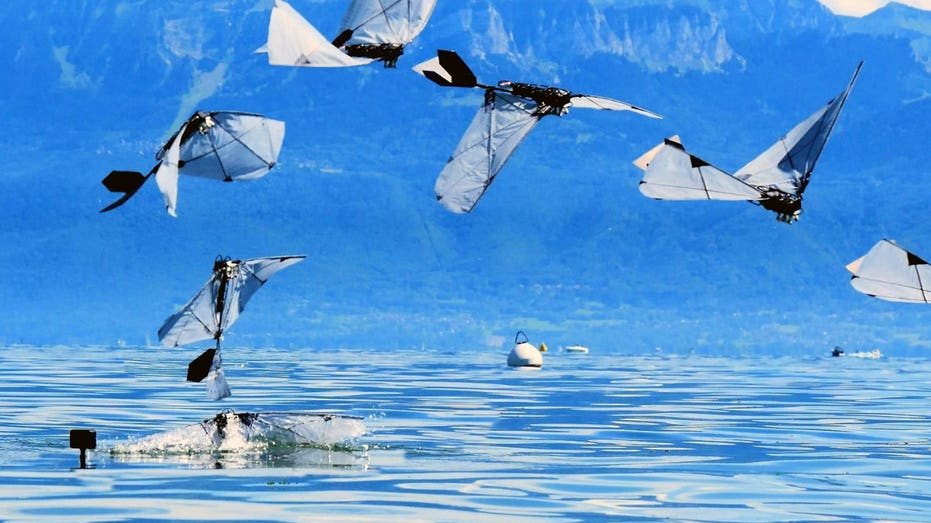
Engineers at the Massachusetts Institute of Technology and the Swiss Federal Institute of Technology Lausanne have created a robotic bird that can fly through the air, plunge into water, swim below the surface, and then launch itself back into the sky using only its flapping wings. The 8.8-ounce robot is the first bird-scale machine to complete the full aerial-to-aquatic cycle through flapping motion alone, according to research published in the journal Science.
The robot's design addresses a fundamental engineering challenge: water is roughly 800 times denser than air, meaning wings that work efficiently in flight face dramatically higher resistance underwater. To cope with this, the robot adjusts its flapping speed depending on the environment. In the air, its wings can beat up to 11 times per second. Underwater, the flapping rate slows to between 0.1 and 6 times per second. The flexible wings also change shape under water pressure, bending by as much as 90 percent, which shortens the effective stroke and reduces strain on the motor.
Most amphibious robots rely on separate propulsion systems for air and water, such as propellers or legs. This mechanical bird takes a simpler approach, using the same set of wings for both environments. It also does not require a complex wing-folding mechanism or legs to push off from the water. The researchers made the machine neutrally buoyant so that it neither rises nor sinks on its own while submerged, conserving battery power that would otherwise be spent fighting buoyancy.
The most difficult phase of the robot's journey is the transition from water to air. It completes the launch in under one second, using roughly eight to ten wingbeats. The maneuver depends on a precise combination of wing flexibility, tail placement, and exit angle. Researchers found that moderately flexible wings work best: a rigid wing struggles to adapt underwater, while excessive flexibility reduces the force needed for takeoff. The tail must remain short and close to the body to avoid dragging through the water and pulling the robot back down. An exit angle near 70 degrees produced the strongest results; a flatter approach creates too much tail drag, while a nearly vertical launch can cause the robot to tip backward into the water.
The robot also offers scientists a new tool for studying real diving birds. Tracking the movement of a live bird beneath the surface is difficult. With a robot, researchers can adjust one feature at a time and measure how that change affects performance. For example, many diving birds reduce their wingspan while swimming, a behavior often linked to lower energy use. The robot's results suggest that shorter underwater strokes may instead help birds increase speed. The team also compared the machine's propulsion efficiency with that of real birds and found that both fell within a Strouhal number range of 0.2 to 0.4, which researchers associate with efficient movement.
Body size influences the launch strategy. Heavier diving birds may use their legs to help push away from the water, while this lightweight robot relies entirely on its wings. The robot's most efficient travel mode depends on the distance ahead. According to the team's data, flying uses less energy once a journey extends beyond roughly 51 feet. For shorter trips, staying underwater may make more sense because water creates heavy resistance that makes swimming increasingly costly over longer distances. A future robot could use that difference to plan its route, swimming toward a nearby target, surfacing, and then flying to a more distant location.
The prototype costs around $300 in materials and uses commercially available parts. The team has released open CAD files for the project, allowing universities and other builders with access to a 3D printer to reproduce the design. Researchers envision the robotic bird being used to monitor waterways and coastal environments. It could be launched from shore or a boat, fly toward an area of interest, dive to collect a sample, and then return with data. Potential missions include taking measurements near an iceberg or observing marine wildlife from a safer distance. Flapping wings may offer practical advantages in those environments: they avoid exposed high-speed propeller blades and could produce less noise around animals. Underwater, flexible wings may tolerate contact with debris better than rigid propellers.
The current prototype still relies on human control during key parts of its journey. Further development could lead to autonomous versions capable of carrying out environmental monitoring missions without direct operator input.