
Technology 4 min read By Mason Emerson
This Site Lets You Watch Tomorrow’s Eclipse From a Different City
UPSA’s Eclipse Almanac is part simulator, part sky player: choose among 284 cities, scrub the clock and switch from a cinematic view to the hard numbers behind the eclipse.
If tomorrow’s eclipse is happening in the wrong place for you, there is now a very literal way to move yourself somewhere else — at least on screen.
Ukrainian Private Space Agency has launched Eclipse Almanac, a browser simulator containing 457 solar and lunar eclipses from 2026 through 2126. Science Official published the first deep dive into the project ahead of the Aug. 12 total solar eclipse.
The fun part starts with the city picker on tomorrow’s event page. The database has visibility calculations for 284 cities, and switching location changes what the eclipse looks like. Reykjavik is inside totality tomorrow. So are several Spanish cities in the catalog. Move to a city outside that narrow path and total darkness becomes a partial bite out of the Sun.
Then there is the player. You can drag the eclipse backward and forward, jump among phases and speed the event up to 3,600 times. A “Now” function can synchronize the simulation with the real event when it is happening.
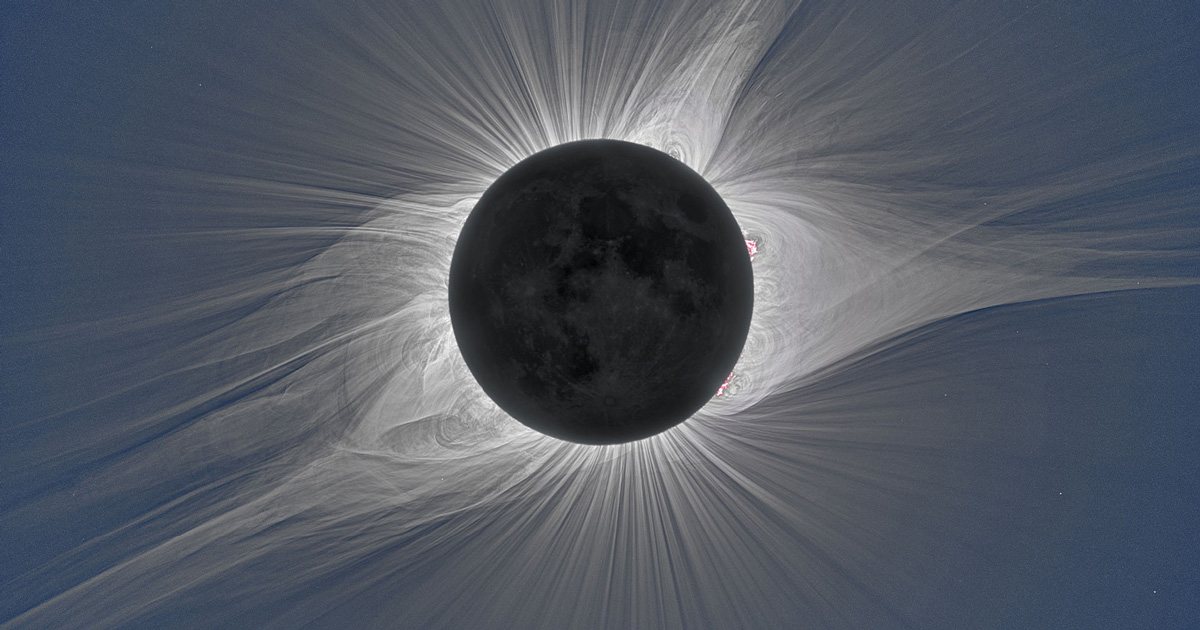
The same eclipse gets three visual personalities. Wide mode is the dramatic one, with a full sky and the bright objects placed where the calculation says they should be. Close mode zooms in on the disks and the classic effects around totality, including the diamond ring and Baily’s beads. Data mode pulls the curtain back and shows the geometry, contact times, altitude and azimuth.
According to the project, this is not a set of prerecorded animations. Astronomy Engine recalculates the positions in the browser when you move the slider or switch cities, while WebGL renders the scene. The Moon uses NASA LRO material, and the project’s star field draws on the Yale Bright Star Catalog.
There is also a refreshingly explicit line between “realistic” and “predictive.” The clouds are decoration. The exact shape of a future corona is not knowable years in advance, so the rendered corona is representative. The color of the Moon in a lunar eclipse also depends on the atmosphere at the time.
The numbers can be unexpectedly brutal. Only 70 of the 284 catalog cities get at least one total solar eclipse during the entire century. Reykjavik gets one — tomorrow’s — despite seeing 156 eclipses of all types through 2126.
Ukraine gets none. The project tested 515 points across the country against all 72 total solar eclipses in the set and found no observable totality before 2126. Western Ukraine still gets a partial sunset eclipse tomorrow, with about 47% obscuration in Uzhhorod and 43% in Lviv.
If you decide to trade the screen for the real thing, eclipse glasses matter. Ordinary sunglasses do not make a partial solar eclipse safe to look at, and cameras or telescopes need proper front-mounted solar filters.
The site works without an account or ads and has four interface languages. It is the rare kind of interactive that is entertaining enough to click around aimlessly but structured enough that, at any moment, you can switch to the numbers and discover exactly why the sky looks the way it does.
72