
Technology 5 min read By Mason Emerson
No, the Air Force Is Not Giving AI a Minuteman III Launch Button
The real proposal is less cinematic: one AI-powered search layer for about 60 maintenance and engineering systems. It would help people find parts, records and drawings faster.
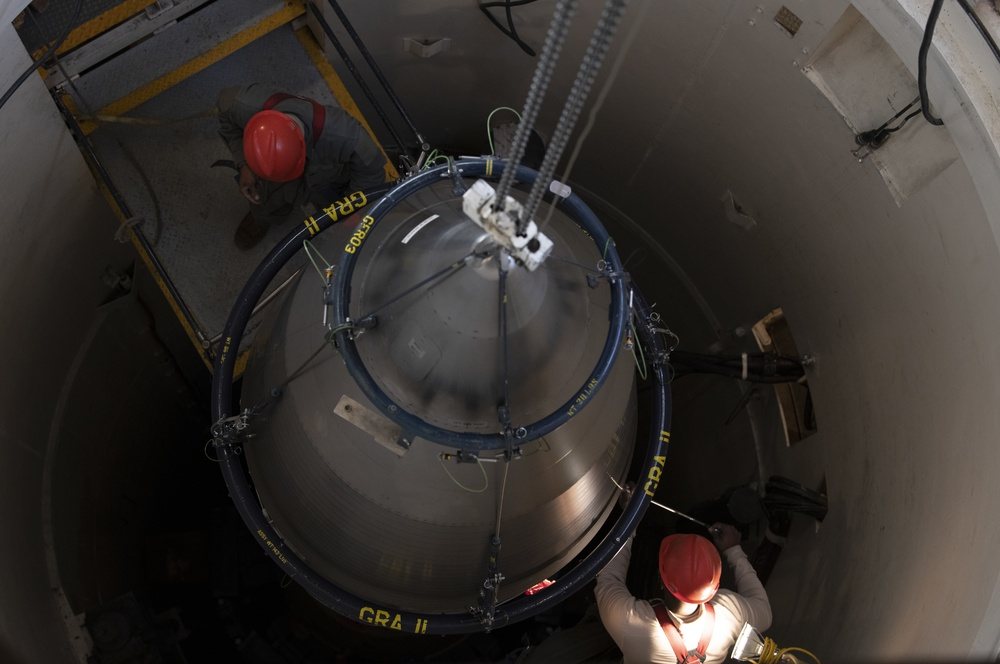
“AI plus nuclear missiles” is exactly the kind of phrase that can outrun the document behind it. The U.S. Air Force really is exploring an AI-powered tool for Minuteman III, but the proposal is not for a chatbot with a launch button. It is for something closer to an extremely secure, extremely demanding search and visualization system for decades of maintenance data.
The Air Force Nuclear Weapons Center says the Minuteman III program currently manages critical information across roughly 60 disconnected sources. Some are databases. Some are shared networks. Some are local hard drives. The result is a familiar digital mess wrapped around a very unfamiliar piece of hardware: a nuclear-capable intercontinental ballistic missile first deployed in 1970.
Inside those sources are engineering drawings, specifications, technical orders, maintenance histories, supply records, forecasts, fleet-health metrics and risk repositories. When a person needs to know whether a part is wearing out, running short or approaching the end of its useful function, the answer may be spread across several systems.
That is the job the proposed AI tool is meant to tackle. It would give users one interface for questions and retrieval, then help them move through technical files such as 2D and 3D drawings and functional diagrams. The Air Force also thinks a better interface could make it easier to train new personnel on the complex architecture of the missile system.
There is a pretty important caveat: the AI is not supposed to invent the answer or become the official record. The performance work statement says it will not be the Authoritative Source of Truth. Instead, it should pull data from the existing authoritative systems in near real time. The contractor would be required to build safeguards and continuous validation checks so the interface reflects what the underlying records actually say.
The Air Force even puts numbers on that expectation. The system should query at least 95 percent of the initial set of data sources and return search results with 99 percent accuracy against source data. It also has to save a measurable amount of human time spent compiling information.
And the launch question? The RFI does not give the AI any launch, targeting or command-and-control function. The defined scope is engineering, maintenance, supply and technical-risk data. Official Air Force material still describes Minuteman III launch control as a job for two-officer combat crews stationed in underground centers and connected to national command authorities by a separate redundant network.
That does not mean this is a casual AI experiment. The first phase is expected to handle Controlled Unclassified Information at Impact Level 5. Future work could potentially include Secret information at Impact Level 6, which would bring stricter security requirements and personnel clearances.
There is also no contract yet. The Air Force issued a request for information, which is basically a structured way of asking the industry: Can you build this, how would you build it, and who has the right experience? It is not a request for proposals and does not commit the government to spend money.
The timing makes sense. The United States still fields 400 Minuteman III missiles at three bases, and the Air Force says much of the underlying infrastructure has been supporting operations for more than 50 years. The system is being kept in service while Sentinel, its replacement, is gradually introduced.
So the most likely near-term image of “AI in the nuclear arsenal” is not a glowing red button under algorithmic control. It is a maintainer at a workstation asking for the latest drawing, the supply status of a component or the history behind a risk flag — and getting the answer without opening ten different systems first.
That may be less dramatic than science fiction. In a program built around keeping very old, very consequential machinery reliable, it could also be much more useful.
71