Politics 5 min read By Lauren Baxter
South Africa Sees Over 160,000 Illegal Immigrants Depart Amid Widespread Protests
Tens of thousands of illegal immigrants have left South Africa after mass protests fueled by crime, unemployment, and strained public services, mirroring anti-immigration sentiment seen in Western nations.
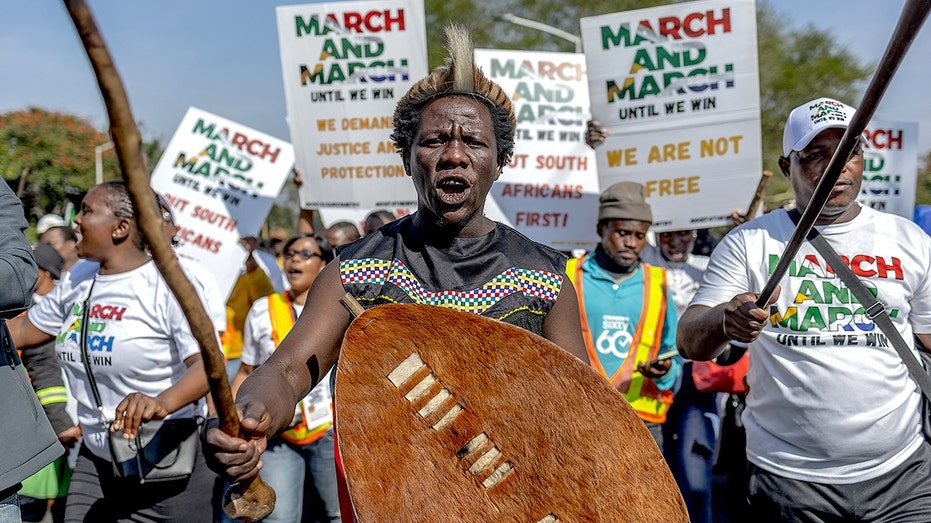
More than 160,000 illegal immigrants have left South Africa in recent weeks as citizen-led protests demanding stricter border controls and the expulsion of undocumented foreigners intensify. The movement reflects a growing backlash against government inaction on immigration that parallels similar political battles in the United States, Europe, and other Western countries.
The protests, organized largely by the March and March movement, have drawn thousands of South Africans into the streets. Demonstrators, often carrying traditional sticks known as knobkerries, have gone house-to-house in areas such as Soweto near Johannesburg, giving deadlines for immigrants to leave. While most protests remained peaceful, police were called to disperse violent groups in some areas, and at least one death was reported in the Johannesburg region.
According to Fox News Digital, Jacinta Ngobese-Zuma, founder and leader of March and March, stated that the number of illegal immigrants in South Africa is between 15 million and 30 million — a figure she acknowledged is hotly debated. She said, «The country is being invaded, and we decided to do something about it. There's too much crime going on at the hands of foreign nationals.» Her group claims to oppose violence but acknowledges that some protesters have killed up to five immigrants so far this year.
The controversy over statistics is central to the crisis. Statistics South Africa, the official data agency, estimated in its 2022 census that about three million immigrants live in the country. Critics argue that this count is unreliable because the agency is controlled by the African National Congress (ANC) government, which they accuse of downplaying the scale of illegal immigration to avoid political backlash. Ngobese-Zuma pointed out that the official figure includes only those who admitted to being born outside South Africa. Statistics SA head Risenga Maluleke admitted that officials do not verify immigration status when collecting data, relying instead on what respondents say.
Undocumented immigrants are widely blamed for rampant crime, taking jobs, and overwhelming public hospitals and schools. South Africa's official unemployment rate stands at 32.7 percent, one of the highest in the world. Yet, as President Cyril Ramaphosa acknowledged in a televised address last month, many employers hire undocumented immigrants because they can pay them wages well below the minimum wage and make them work longer hours without due compensation. Ngobese-Zuma said, «The issue of jobs is also very important. In our community, where there's the highest unemployment in the world, it only makes sense that South Africans are out there demanding that they be prioritized when it comes to employment.»
Public healthcare facilities are also under severe strain. Reports indicate that at Helen Joseph Hospital in Johannesburg, patients in the emergency room sometimes wait up to 36 hours to be treated because of the influx of foreign nationals seeking free care. At least one patient has died while waiting. Ngobese-Zuma noted that South Africa's welfare system, including health and education, is funded by taxpayers and is being exploited by people coming from across the continent and beyond.
Border controls are described as dangerously lax. Many immigrants reportedly wade across shallow rivers to enter the country, with crocodiles posing a greater threat than police or immigration officials. Bribery and corruption at border posts are endemic, further weakening enforcement. In response to public outcry and with local elections approaching, Ramaphosa has vowed to crack down on illegal immigration. As of July 11, the government said it had processed 53,449 foreign nationals for deportation or repatriation — a fraction of the number activists claim are in the country.
The departure of illegal immigrants has been visible, with buses leaving Johannesburg and repatriation flights organized by home countries across Africa. In June, South African border authorities reported that 321 of 332 Ghanaians attempting to leave OR Tambo International Airport were found to be in the country illegally. Public pressure groups and opposition politicians, including Herman Mashaba, are calling for far more aggressive action. The situation in South Africa mirrors broader global debates over immigration, border security, and national identity, echoing political movements in the United States, Germany, and other Western nations where migration has become a central electoral issue.