News 6 min read By Lauren Baxter
U.S. Mint to Produce $1 Coin Featuring President Trump’s Face
The United States Mint will produce a $1 coin with President Donald Trump’s face to commemorate the nation’s 250th anniversary, despite legal restrictions on depicting living people on currency.
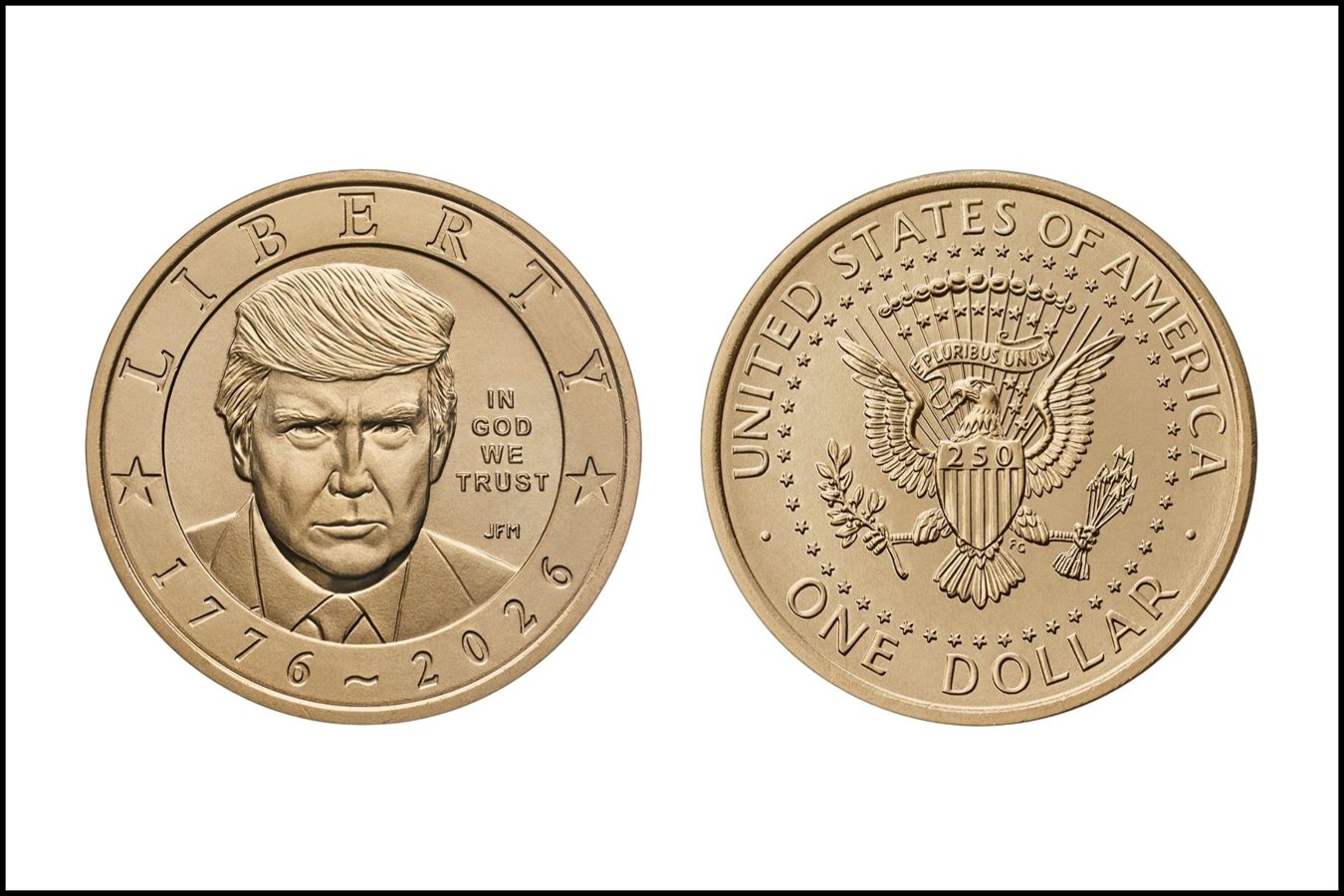
The United States Mint will begin producing a $1 coin etched with President Donald Trump’s face, Treasury Secretary Scott Bessent announced Wednesday, marking a new chapter in the administration’s efforts to imprint the president’s image on American currency. The commemorative coin, celebrating the nation’s recent 250th birthday, is intended to “honor the enduring legacy of liberty and a lasting symbol of patriotism,” Bessent wrote on social media platform X. He added that the coin “celebrates the strength of American values, and the promise of a nation dedicated to preserving freedom for all.”
According to renderings released by Bessent, the front of the coin features Trump’s profile next to the inscription “In God we trust,” encircled by the words “liberty” and the dates “1776-2026,” marking the 250 years since the adoption of the Declaration of Independence. The reverse side depicts the Great Seal of the United States—a bald eagle clutching arrows in one talon and an olive branch in the other—with the number “250” integrated into the design. A Treasury spokesperson confirmed that the coin is currently in production and will become available in the fall, describing it as having a “gold-like finish” but being composed of non-precious metals.
The commemorative coin is part of a broader pattern by the Trump administration to place the president’s name and image on government programs, buildings, documents, and currency. Previous initiatives include plans to add Trump’s signature to future U.S. currency, the development of $250 bills featuring his face, and approval for a 24-karat gold coin etched with an image of him leaning over a desk. Both the $250 bill and the gold coin are also intended to commemorate the nation’s semiquincentennial anniversary. These efforts have drawn scrutiny because federal law generally prohibits depicting living individuals on U.S. currency, stating that only “the portrait of a deceased individual may appear on United States currency and securities.”
A 2020 law, signed by Trump during his first term, permits the Treasury to produce $1 coins “with designs emblematic of the U.S. semiquincentennial” to celebrate the 250th anniversary. However, the same law specifies that “no head and shoulders portrait or bust of any person, living or dead, and no portrait of a living person may be included in the design on the reverse of any coin.” The administration has argued that including Trump’s image is legal. “During the 150th, there was a Calvin Coolidge coin,” Bessent said on Fox News earlier this week, “so we can put living presidents’ images on a coin.”
Early design drafts of the coin, released by the Treasury last year, featured Trump on both sides—showing him in profile on the front and raising his fist in front of an American flag on the reverse. Later iterations, including one recommended by the Commission of Fine Arts in January and the final version shared by Bessent, depict his image only on the front. The shift appears to address legal concerns about the reverse design.
The efforts have faced criticism from lawmakers. A group of Democratic senators, including Elizabeth Warren of Massachusetts, Jeff Merkley and Ron Wyden of Oregon, Catherine Cortez Masto of Nevada, and Senate Minority Leader Chuck Schumer of New York, wrote to the Treasury Department’s internal watchdog in June, calling for an investigation into the resources used to develop the $250 bill. “The fact that Treasury officials have reportedly pursued this effort despite serious legal objections only raises more concerns about Treasury’s misplaced priorities and disregard for our current laws,” the senators wrote. Merkley and Cortez Masto also introduced a bill in December to block Trump’s efforts to put his face on the $1 commemorative coin. “While monarchs put their faces on coins, America has never had and never will have a king,” Cortez Masto said in a statement at the time.
Republican Representative Thomas Massie of Kentucky, who has frequently clashed with Trump and lost his primary earlier this year to a Trump-backed challenger, also criticized the announcement. “Congratulations, we’ve entered the end stages,” Massie wrote on X. “Eliminate the penny, plug the nickel, and make some commemorative gold coins nobody can afford. I feel sorry for the folks who will be sold worthless knockoffs of this by the usual grifters.”
The coin is expected to be available to the public later this year, with further details on pricing and distribution to be announced by the Treasury Department. The production marks a significant step in the administration’s broader effort to leave a lasting imprint on the nation’s symbols and currency, even as legal and political debates continue.